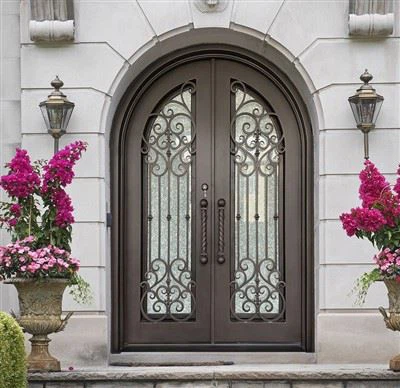
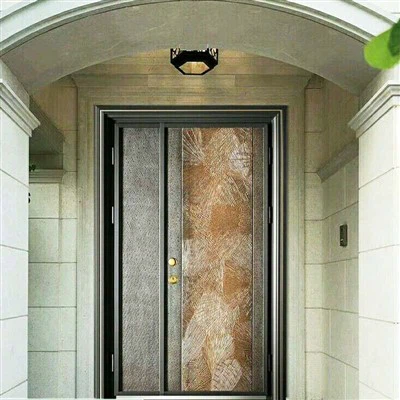
The beauty and safety of wrought iron doors depend largely on the quality of hinges and locks. If the hinges are loose or the locks are not firm, it will not only affect the user experience, but may also bring safety hazards.
1. Selection of wrought iron door hinges
Hinges (hinges) are the core components that support the opening and closing of the door body, and their quality directly affects the stability and service life of the door.
1. Selection of hinge materials
Wrought iron doors are heavy, so you need to choose high-load-bearing, rust-proof, and wear-resistant hinge materials:
Stainless steel hinges (recommended)
Advantages: corrosion-resistant, rust-proof, suitable for outdoor use, strong bearing capacity (304 stainless steel is best).
Applicable scenarios: coastal, humid areas or high-end wrought iron doors.
Cast steel/forged steel hinges
Advantages: high strength, good load-bearing capacity, but the surface needs to be galvanized or spray-painted to prevent rust.
Applicable scenarios: heavy wrought iron doors, which require additional rust-proof treatment.
Copper hinges
Advantages: beautiful, corrosion-resistant, but expensive, average load-bearing.
Applicable scenarios: retro-style wrought iron doors, suitable for low-frequency use.
2. Hinge type selection
Choose the appropriate type according to the weight and installation method of the door:
Ordinary hinges (flat hinges)
Applicable: light wrought iron doors, 3~4 hinges need to be installed to disperse the force.
Heavy hinges (T-shaped hinges, square hinges)
Applicable: large wrought iron doors, single hinges can bear more than 50kg.
Hidden hinges
Applicable: modern style wrought iron doors that pursue beauty, but have low load-bearing.
Removable hinges (bolt type)
Applicable: doors that need to be temporarily disassembled, such as courtyard doors.
3. Hinge installation points
Quantity: at least 3 hinges are installed for a single door (4 hinges are recommended for doors over 2 meters).
Position: The top hinge is close to the door frame, the bottom hinge is close to the ground, and the middle is evenly distributed.
Screw fixing: Use stainless steel expansion bolts to ensure firmness and no looseness.
2. Selection of iron door locks
The locks directly affect the safety of iron doors, and must take into account anti-pry, anti-rust, and durability.
1. Selection of lock types
Mechanical mortise locks (recommended)
Advantages: Strong structure, strong anti-pry, suitable for outdoor iron doors.
Applicable: Villa gate, courtyard door.
Electronic smart lock
Advantages: Password/fingerprint/NFC unlocking, high convenience, some support remote monitoring.
Note: Choose outdoor models that are waterproof and sun-proof to avoid moisture damage to electronic components.
Padlock + lock buckle
Advantages: Simple and economical, but less secure, suitable for temporary use.
Applicable: Garage door, secondary entrance and exit.
Heaven and earth lock (multi-directional lock)
Advantages: Multiple locking points up and down, extremely anti-pry.
Applicable: Iron gates with high security requirements.
2. Lock core grade selection
The lock core is the core of the lock. The higher the grade, the more difficult it is to be unlocked by technology:
A-level lock core (not recommended): easy to be pried open, low security.
B-level lock core (basic): anti-technical opening ≥5 minutes, suitable for ordinary families.
C-level (super B-level) lock core (recommended): anti-technical opening ≥10 minutes, high security.
Smart lock electronic lock core: Some support anti-pry alarm, but the power needs to be checked regularly.
3. Lock material selection
Lock body: stainless steel or zinc alloy is preferred, corrosion-resistant.
Lock tongue: it is recommended to choose anti-saw steel tongue to prevent violent damage.
Surface treatment: electroplating or powder coating to enhance rust resistance.
3. Installation and maintenance suggestions
1. Installation precautions
Hinge installation: ensure that the door is aligned with the door frame to avoid deformation caused by uneven force.
Lock installation:
The lock hole position needs to be accurately opened to avoid the lock tongue from getting stuck.
Electronic locks need to be waterproof and sealed (such as installing rain covers).
Reinforcement measures:
Anti-pry steel plates can be installed on the door frame to improve safety.
It is recommended to install floor springs on heavy doors to reduce hinge pressure.
2. Daily maintenance
Check whether the hinge screws are loose every 3 months and tighten them in time.
Add lubricating oil (such as WD-40) to the hinges and lock cylinders every six months to prevent rust and jamming.
Check the waterproofness of the locks before and after the rainy season, and replace the batteries of electronic locks (if applicable).
If rust is found, sand it with sandpaper and repaint it in time to avoid deterioration.